Foot Pathologies: Diagnosis and Treatment
The foot is a complex structure composed of bones, joints, tendons, and ligaments that work together to ensure stability, balance, and movement. Alterations in this balance can lead to the onset of various foot pathologies, often responsible for pain, walking difficulties, and limitations in daily activities.
Dr. Andrea Bianchi, orthopedic surgeon and creator of the PBS (Percutaneous Bianchi System) technique, together with his team of specialists, focuses on the diagnosis and treatment of the main forefoot pathologies, adopting a minimally invasive approach that respects the physiology of the foot.
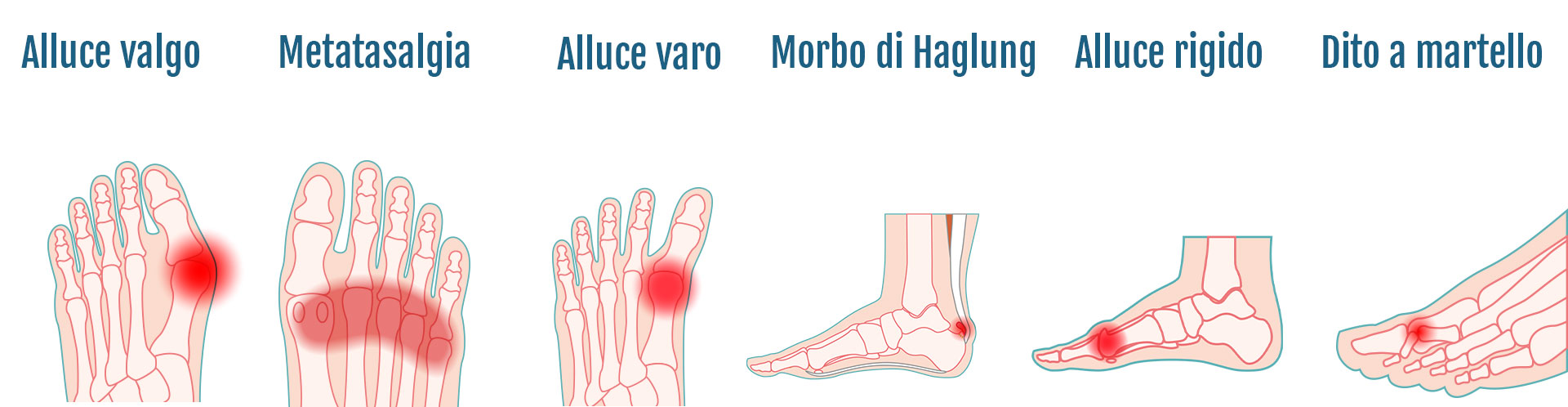
The Main Forefoot Pathologies
Among the most common conditions treated by the PBS team are:
Hallux Valgus
Hallux valgus is a deformity characterized by the deviation of the big toe toward the other toes and the formation of a bony prominence at the base of the first toe. It can cause pain, inflammation, and difficulty wearing footwear.
Hallux Rigidus
This is a degenerative condition of the big toe joint that causes stiffness, limited movement, and pain during walking.
Hallux Varus
Less common than hallux valgus, hallux varus is characterized by a deviation of the big toe toward the inside of the foot. It may be congenital or appear as a consequence of previous surgical procedures.
Hammer, Claw, and Mallet Toes
Toe deformities are alterations in the position of the phalanges that can cause pain, calluses, and difficulty wearing shoes.
Metatarsalgia
Metatarsalgia is a painful condition affecting the front part of the foot, often related to an altered distribution of loads during walking.
Haglund’s Syndrome
Haglund’s syndrome is a pathology characterized by a bony prominence on the back of the heel that can irritate the Achilles tendon and surrounding tissues.
A Personalized Approach to Foot Care
The treatment of foot pathologies always requires an accurate specialist evaluation, which allows understanding the causes of the disorder and identifying the most appropriate therapeutic pathway.
In many cases, the initial approach is conservative, using orthotics, physiotherapy, or other targeted therapies. When pain persists or the deformity limits foot functionality, surgical correction may be considered.
The PBS technique represents an evolution in foot surgery, thanks to a minimally invasive approach that allows correction of deformities through small skin incisions, reducing surgical impact and promoting faster recovery.
The Importance of Early Diagnosis
Early recognition of the signs of foot pathologies is essential to prevent worsening of the deformity and preserve proper walking function.
A specialist evaluation allows identification of the cause of the problem and definition of the most appropriate treatment, improving quality of life and enabling pain-free movement.
PBS Percutaneous Surgical Technique for Hallux Valgus
The PBS percutaneous surgical technique (Percutaneous Bianchi System) represents an innovative approach for the correction of hallux valgus and other forefoot deformities. Developed by Dr. Andrea Bianchi, an orthopedic surgeon specialized in foot surgery, this technique was created with the goal of effectively correcting deformities while minimizing surgical impact on tissues.
The PBS method is based on a fundamental principle: respecting the physiology of the foot, addressing the deformity through minimally invasive procedures that allow targeted correction and faster recovery.
What Is Percutaneous Foot Technique
Percutaneous surgery is a technique that allows the procedure to be performed through small skin incisions, avoiding extensive incisions and reducing surgical trauma. In the case of the PBS technique, hallux valgus correction is performed through two small incisions, which allow the surgeon to reshape the bone structures responsible for the deformity.
This approach allows precise intervention, preserving surrounding tissues and maintaining the biomechanical balance of the foot.
Characteristics of the PBS Technique
The PBS technique is distinguished by several specific characteristics:
- minimally invasive approach, with small skin incisions
- procedure generally performed under local anesthesia
- absence of permanent screws or fixation devices
- ability to walk immediately after surgery with a dedicated post-operative shoe
- faster functional recovery compared to traditional surgery.
These characteristics make the PBS method a particularly valued solution for the treatment of forefoot deformities.